A Bloody Battle To Win A B-17 Flying Fortress
Read an excerpt about the crucial Battle of Medenine from my new book, “Monty’s Flying Fortress.” Order your copy here!
In February 1943, Montgomery was raring to fight. When First Army started to flounder, he was willing to step in – despite the fact that his supply situation was only just beginning to resolve itself after his capture of Tripoli. ‘Reverting to the immediate problems . . . my object was to push the enemy back to his next defensive position: the Mareth Line. I would have to drive in his covering troops, “lean” up against his defenses and make a plan to pierce them’, wrote Montgomery later. ‘I had also to secure the necessary centers of communications and lateral roads, and seize the forward airfields: particularly those about Medenine.’
Across the battlefield, Rommel was also planning to attack Montgomery. He had defeated the Americans at Kasserine Pass and, despite his overall weakened and strained condition, had experienced a renewed boost of confidence.
After his victory at Kasserine, Rommel ‘ordered a bottle of champagne, and said he felt like an old war-horse that had heard the music again . . . It was wonderful to see the joy of his troops during the last few days, as he drove along their columns’, wrote Third Reich press attaché Captain Alfred Berndt to Rommel’s wife on 26 February 1943.
‘And when, in the middle of the attack, he appeared . . . right up with leading infantry scouts . . . and lay in the mud among the men under artillery fire in his old way, how their eyes lit up.’
Rommel knew that the Eighth Army was coming for him. He hated being passive and since the First World War had judged that it was ‘better to be a hammer than an anvil’, as he wrote once, in a reference to a do-or-die poem called ‘Ein Andres’ by the famous German poet Johann Wolfgang von Goethe.
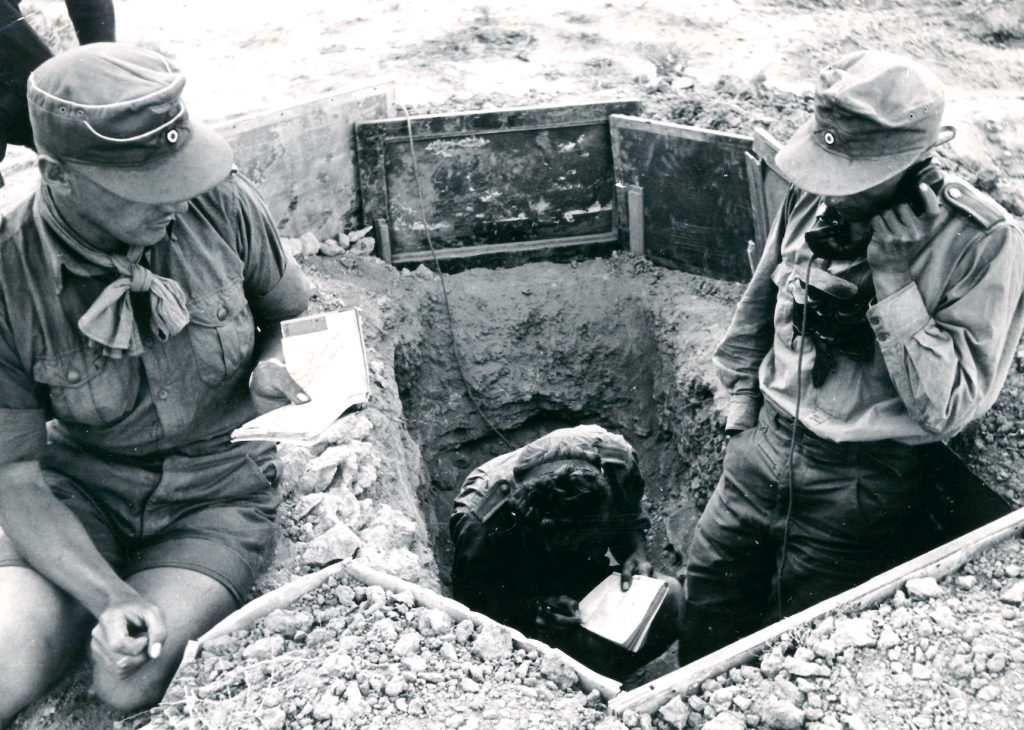
Rommel’s photo of an Afrika Korps communications station sited in a desert dugout. U.S. National Archives.
Medenine was the optimal place to strike. A flat, dusty wilderness mixed with steeply rising hills, it was riddled with rocks and rough terrain that promised to guzzle precious tank fuel and rendered attack avenues limited.
‘An attack against the Eighth Army at Medenine was bound to be an extremely difficult undertaking, not only because of the great battle experience of Montgomery’s troops, but also because of the nature of the terrain, which offered a very small choice of tactical possibilities’, wrote Rommel. Yet, in accord with his philosophy of always being active in harassing the enemy and initiating contact, he was determined to go forward. ‘The decision to make the attack at all was based on the realization that we only had two choices open to us – either to await the British attack on our own line and suffer a crushing defeat, or to attempt to gain time by breaking up the enemy’s assembly areas.’
… The Desert Fox now had resources – and, thanks to improved shipping and supplies delivered from the port at Tunis, more tanks. Rommel’s tanks began moving in for the kill on 27 February.
‘It looked indeed as if my anxieties were justified, and that Rommel had decided to strike at the Eighth Army while there was an opportunity of dealing a crushing blow at its leading divisions’, Monty wrote. ‘He could guess how very stretched we had become, and if he could overwhelm my forward areas before I could get more troops forward . . . he could cause a major setback to my plans . . .’
The usually unflappable Montgomery realized that his situation was dire and rushed to cover his vulnerabilities. ‘I initiated emergency measures to regain balance and to prepare for an enemy attack’, he wrote, uncharacteristically yet candidly using the word ‘emergency’ to describe the scenario facing him. Even in such high anxiety, however, Montgomery acted with typical focus and precision. Somehow he managed to think of every detail of his defense, and leave no stone unturned despite his tremendous haste.
Organizing his defenses a la carte, Montgomery managed to stage manage what he might have called ‘a very tidy show’ in short order, with anti-aircraft batteries planted in the hills to destroy German Stuka dive-bombers and – in a clever riff on one of Rommel’s own techniques – over 500 anti-tank guns placed well forward to blast German armor to smithereens.
‘Very great care had been taken in positioning our anti-tank guns, and it should be noted that they were sited to kill tanks at point-blank range’, wrote Monty, ‘and not to defend the infantry.’
After having ordered some 400 tanks up forward, Montgomery waited and hoped that Rommel would not strike before 4 March. ‘I should then be ready for any move by Rommel, and would be so strong and well positioned that I might give him a rude shock and inflict on him heavy casualties’, wrote Monty. ….
Rommel himself knew that he was losing the initiative and failed to pull off the attack in the time he wanted. In the wake of his disobedience to Hitler and Mussolini, Rommel had been placed in the military equivalent of the time-out corner under the supervision of a series of Italian generals who were unsure of what they were doing, and who in turn waited upon the word of Mussolini, who knew less.
Supposedly assisting them were German officers, notably Field Marshal Albert Kesselring, with Von Arnim – Rommel’s intended usurper – recently added to the mix. Whenever Rommel presented an idea, a host of German and Italian voices disagreed and no clear directives ensued.
One thing was clear, and that was that Rommel was not taken seriously anymore due to his political criticisms of, and disobedience towards, Hitler and Mussolini, and his freedom of action was thus exceedingly limited. Although he had no idea of the extent of Montgomery’s preparations, Rommel still hoped to achieve surprise.
When he finally did get cleared to carry out a plan that was not entirely of his own making, Rommel had lost eight days.
During that time, it was Montgomery who seized the moment: ‘We had no wire and no minefields, but the positioning of the infantry and siting of the anti-tank guns, together with the strong reserves of armor, gave our defenses great strength, and I was confident we would repulse the enemy and give him a sharp lesson.’
What occurred at Medenine was a gory orchestra of thundering antitank guns and exploding German tanks. Hoping for surprise, Rommel had inadvertently sent his Panzers into a hornet’s nest with stingers waiting for their arrival from all corners. Three Panzer divisions were annihilated one after another as Montgomery ripped them to shreds, destroying fifty-two tanks in total, of which forty-five were ripped apart by the ferocious barrage of anti-tank guns.
To add insult to injury, Montgomery only deployed a single squadron of his 400 tanks – and none of them were destroyed.
Rommel was galled by what had occurred. ‘The British commander had defensively deployed his troops exceptionally well and was in position to execute his maneuvers with extraordinary speed’, he wrote afterwards.
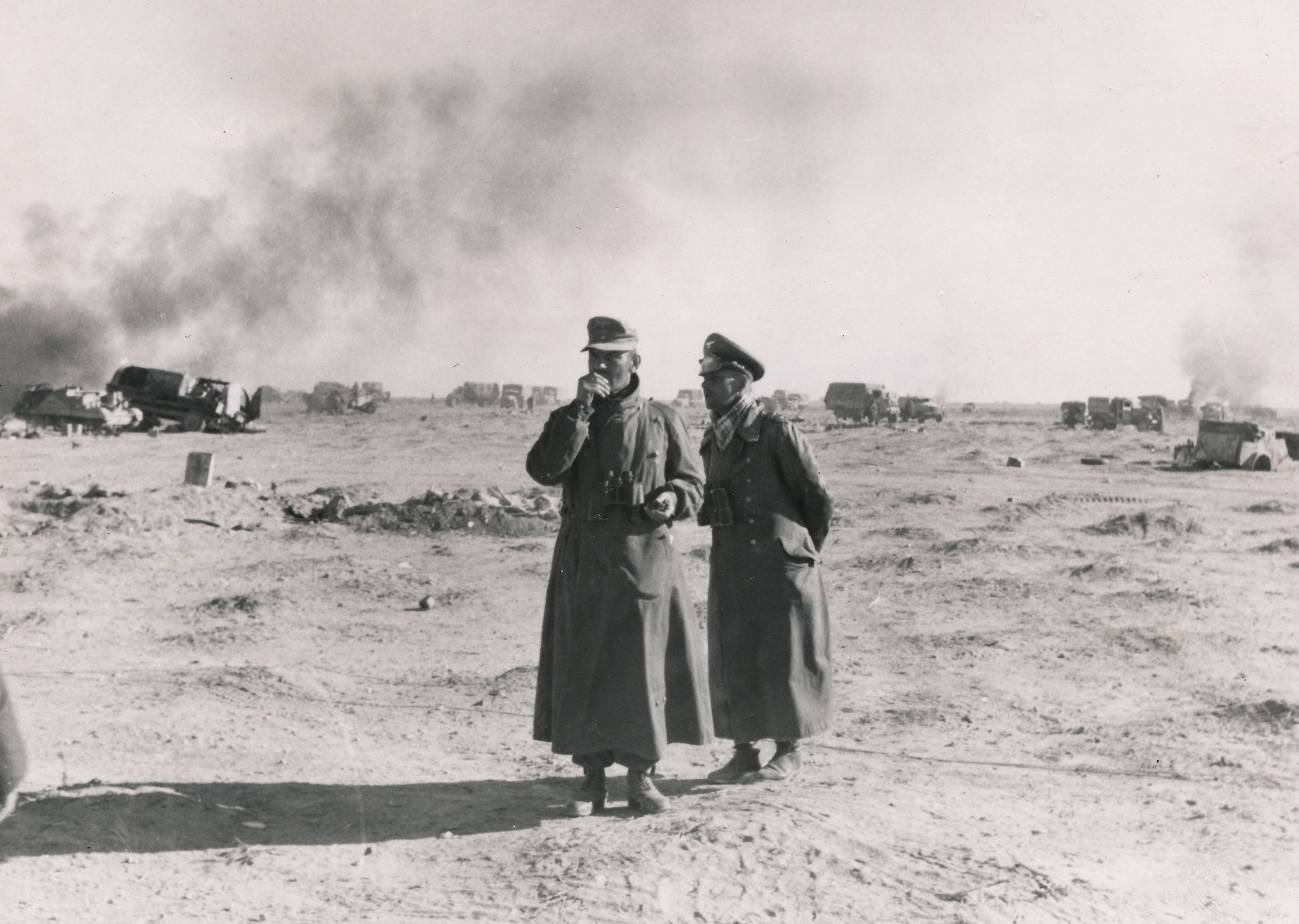
Driving up to the front line in the gloom of dust and smoky skies after hours of desperate and doomed fighting, Rommel called the attack off and pulled his troops out to avoid further losses.
‘On this day, we suffered most extreme casualties’, he wrote, although apparently he had been so focused on the tanks blown apart by the gun barrage that he counted only some forty lost.
It left Rommel, already clinging to mere shreds of hope of sustaining his troops’ efforts, utterly demoralized.
‘Yet the most painful thing was the realization that we in the meantime had never been in a position to disrupt Montgomery’s advance. Everywhere among us reigned a feeling of total depression’, described Rommel, of the sense that the Panzer divisions and their tank crews had been doomed from the start.
The battle at El Alamein had been one of the worst things that had befallen Rommel from a personal and professional standpoint until that point….Rommel had spent months afterwards trying to use his wits to devise creative ways of preserving his army from destruction – at the expense of his military reputation.
Now, the pitched battle that Hitler and Mussolini had been hoping for was unavoidable. He was now facing a repeat performance of El Alamein. ‘The attack of the Eighth Army stood before us now – and we had to prepare for it’, he wrote. ‘For the [Axis] Army Group to stay any longer on the African continent was now the equivalent of suicide.’